
3 Exercise Glycogen
Before attempting this tutorial you must have read chapter “Gluconeogenesis and Glycogen” or attended the corresponding lecture.
Exercise 1
A 46-year-old woman noting episodes of fatigue and confusion for the past 6 months as she finished her daily pre-breakfast jog. The episodes were occasionally accompanied by blurred vision and an unusually urgent sense of hunger. The ingestion of food relieved all of her symptoms within 25-30 min. In the last month, these attacks have occurred more frequently throughout the day, and she learned to reduce the severity by eating between meals. As a result of this increase in caloric intake, she gained 4kg of weight.
- Question
- Answer
What would you recommend testing to make a diagnosis?
Blurred vision and hunger point to low glucose levels before breakfast. Measure glucose levels before breakfast, particularly after exercise.
- Question
- Answer
What might be the underlying reason?
Could it be an inherited disorder?
| There could be a variety of reasons. Before breakfast, gluconeogenesis is the main source of glucose. Gluconeogenesis is upregulated by glucagon and downregulated by insulin. Glycogen is also contributing to glucose production. Glycogen breakdown is upregulated by glucagon while insulin increases glycogen content. Hormonal imbalance could be a reason. The condition appears to be acquired as the proband is 46 years old and the symptoms increased over the previous 6 months. |
- Question
- Answer
The levels of which hormones would you test in this patient?
Insulin and glucagon, the main hormones that regulate blood glucose.
- Question
- Answer
Which hormone might be elevated?
Most likely insulin, because blood glucose levels are low and insulin removes glucose from blood.
- Question
- Answer
Consider age of onset and progression over the previous 6 months and suggest a diagnosis.
A rare insulin-producing tumour (note the age of the proband and the increasing severity of the symptoms) causes insulin hypersecretion, which in turn causes hypoglycaemia.
Exercise 2:
A girl appeared normal at birth but developed signs of liver dysfunction and muscular weakness at the age of three months. Her liver was enlarged; she had periods of hypoglycaemia (low blood glucose), particularly upon awakening; and she showed hyperlipidemia and fasting ketoacidosis. Liver enzymes were found in blood plasma. A liver biopsy revealed an elevated glycogen content and no debranching enzyme. Muscle biopsy demonstrated a similar finding.
- Question 1
- Answer 1
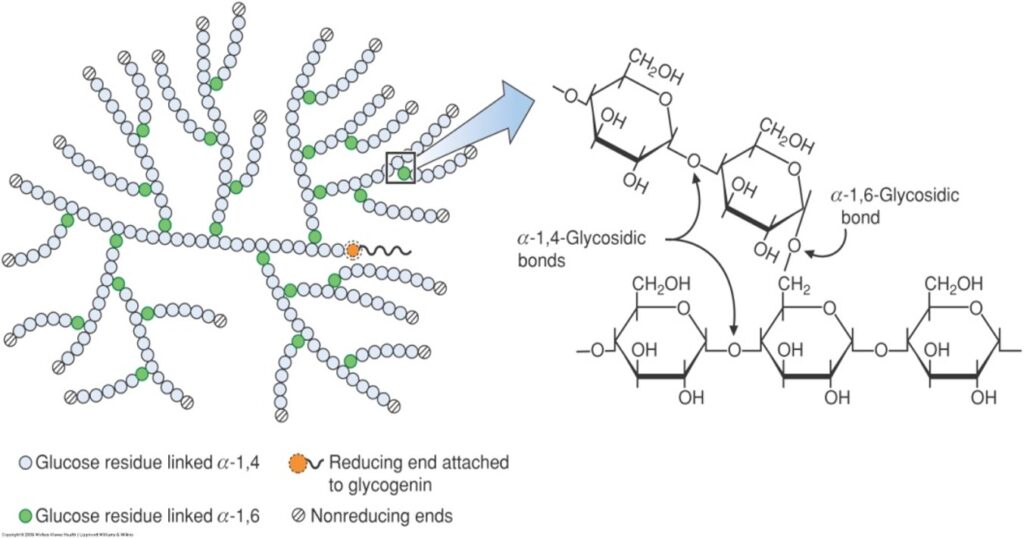
How would the structure of glycogen look like in the cells of this girl before a meal and after a meal?
After a meal the structure of glycogen would look normal as depicted above. Between meals glycogen breakdown would occur but can only proceed to the branching-points.
- Question 2
- Answer 2
Why was the liver enlarged?
Because the glycogen particles can grow, but only shrink to the next branching point, the liver will generate additional and larger glycogen particles. This causes enlargement of liver cells.
- Question 3
- Answer 3
What happens if the child receives carbohydrate rich nutrition?
Due to the problem of glycogen breakdown, large meals would enlarge the liver further. Frequent small meals are preferred over large carbohydrate-rich meals.
- Question 4
- Answer 4
Could glucose be produced during fasting?
Yes, glucose production by gluconeogenesis is not affected. Hypoglycemia is most likely to occur during early fasting.
Exercise 3:
A 4-year old boy was hospitalised with fever, vomiting, and diarrhoea that was thought to be due to viral gastroenteritis. A blood test was performed and revealed an elevated concentration of glycerol (2.5 mM, normal 0.02-0.27 mM). Urinary glycerol was 90 mM (normal < 0.2 mM).
The episodes recurred over the next few years and on occasion he became unconscious.
- Question 1
- Answer 1
What are the sources of glycerol residues in the body?
Most of the glycerol in the body is generated through hydrolysis of fat. Smaller amounts can be derived from glycerolipids.
- Question 2
- Answer 2
What metabolic intermediates look similar to glycerol? What metabolic fate could glycerol have?
The structure of glycerol is related to glyceraldehyde-3-phosphate and dihydroxyacetone-phosphate, which are metabolites of glycolysis. Glycerol can be converted into these glycolytic intermediates. Glycerol can be used in gluconeogenesis and glycolysis.
- Question 3
- Answer 3
What might be the underlying reason?
The young onset suggests an inherited defect, in this case a defect of an enzyme that affects the conversion of glycerol into intermediates of glycolysis/gluconeogenesis.