
4 Exercise Oxidative phosphorylation
You must read chapter 10 before attempting this tutorial.
The Oxygen electrode
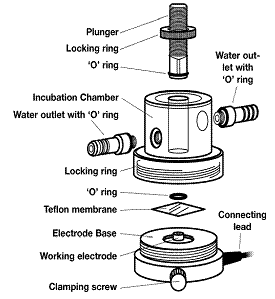
The oxygen electrode has been used extensively to elucidate the components of the respiratory chain. The electrode is typically embedded underneath a vessel that contains a buffer solution. A plunger with an O-ring seals the vessel to avoid mixing of atmospheric oxygen with the oxygen in the buffer solution. The buffer solution is saturated with dissolved oxygen (240 μmol/L), but once all oxygen is consumed no further oxygen can enter the vessel. The oxygen electrode itself is separated from the buffer by a teflon membrane through which oxygen can pass, but no component of the buffer solution (Fig. 1).
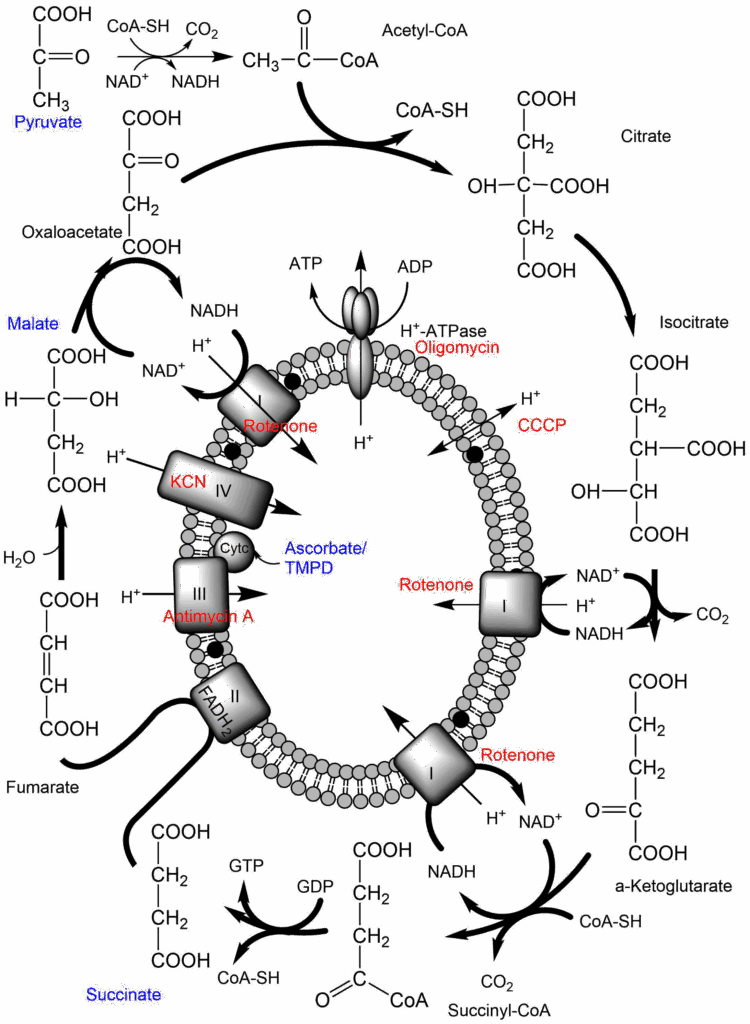
In each of the following questions a typical oxygen electrode experiment is shown. The oxygen trace starts at saturation and oxygen is reduced by consumption through the respiratory chain. Oxygen (in μmol/L) starts at 240, which is saturated buffer. Metabolites and inhibitors are added and the changes to oxygen levels recorded. Please consult Figure 2 to identify the action of inhibitors and metabolites. You can go to the next step of the experiment by clicking on the arrows.
Experiment 1

- Question 1
- Answer 1
Why is there no oxygen consumption when pyruvate is added alone?
During isolation the metabolite content of mitochondria would be depleted, because the membrane is permeable to TCA cycle intermediates. Thus, without TCA cycle metabolites present, pyruvate will not be oxidized. The membrane is impermeable to the coenzymes which remain inside the mitochondria.
- Question 2
- Answer 2
Why does oxygen consumption increase when malate is added?
Malate can be oxidized by malate-dehydrogenase yielding NADH and oxaloacetate. Whether the TCA cycle continues would depend on the presence of acetyl-CoA starting the TCA cycle (pyruvate was added). NADH from malate dehydrogenase will feed into the respiratory chain. Because very little endogenous ADP is present, the respiratory chain runs slowly. This is due to the backpressure building up when protons are transported by Complex I, but the proton-motive force cannot be released through the ATP synthase. Some leaks in the membrane let protons through resulting in low level oxygen consumption. Please note that oxygen consumption requires electrons to flow all the way to Complex IV
- Question 3
- Answer 3
Why does oxygen consumption increase further when ADP is added?
The oxidation under condition (2) would rely on small proton leaks in the mitochondrial membrane. Addition of ADP greatly increases the speed of the ATP synthase, which releases the backpressure by using the proton gradient, allowing the respiratory chain to run.
- Question 4
- Answer 4
What happens if you add CCCP (has the same properties as Dinitrophenol)?
CCCP will uncouple ATP synthesis from the respiratory chain by short-circuiting the flow of protons. The flow of protons through ATP synthase is no longer required to dissipate the proton-motive force.
- Question 5
- Answer 5
Why does oxygen consumption fail to react to addition of ADP in the presence of CCCP?
The respiratory chain will run uninhibited in the presence of CCCP using oxygen at maximum rate, but no ATP is produced. CCCP continuously dissipates the proton gradient. Addition of ADP therefore does not increase the consumption of oxygen.
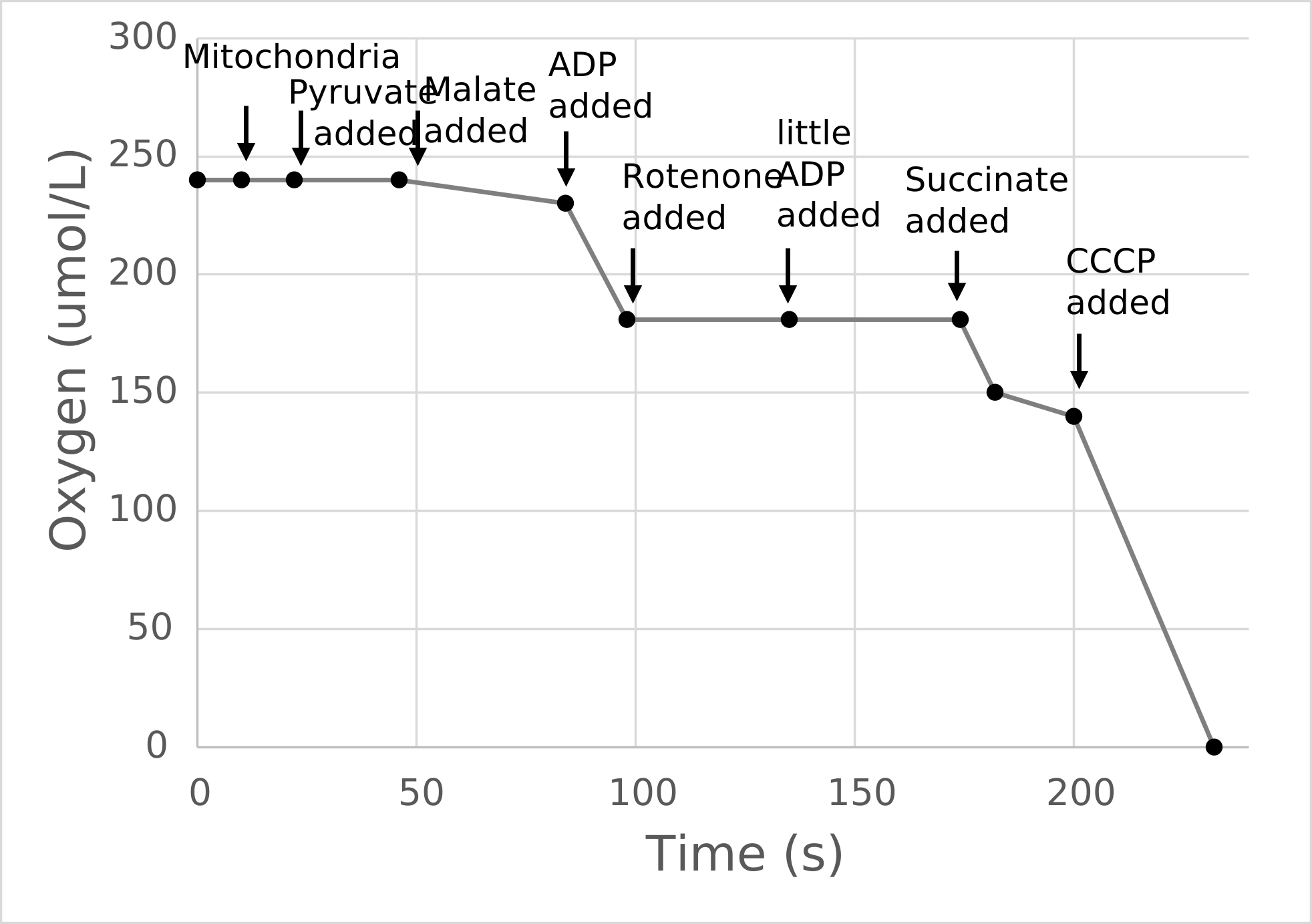
Experiment 2 The effects of Rotenone.
- Question 1
- Answer 1
Why does respiration stop after addition of rotenone?
Rotenone is an inhibitor of complex 1. Malate generates NADH, which delivers electrons to complex 1. No oxaloacetate is generated to continue the TCA cycle.
- Question 2
- Answer 2
Why does respiration resume after addition of succinate?
Succinate is a substrate of succinate dehydrogenase (Complex II). It delivers electrons to FAD, which in turn delivers electrons to ubiquinone and the other complexes of the respiratory chain, thereby bypassing complex 1. The experiment allows the conclusion that Complex 2 must be sitting downstream (or parallel) to Complex 1.
- Question 3
- Answer 3
What happens after addition of CCCP?
CCCP release the backpressure by dissipating the proton motive force without producing ATP. The respiratory chain will run uninhibited in the presence of CCCP using oxygen at maximum rate without producing ATP. Addition of ADP therefore does not increase the consumption of oxygen.
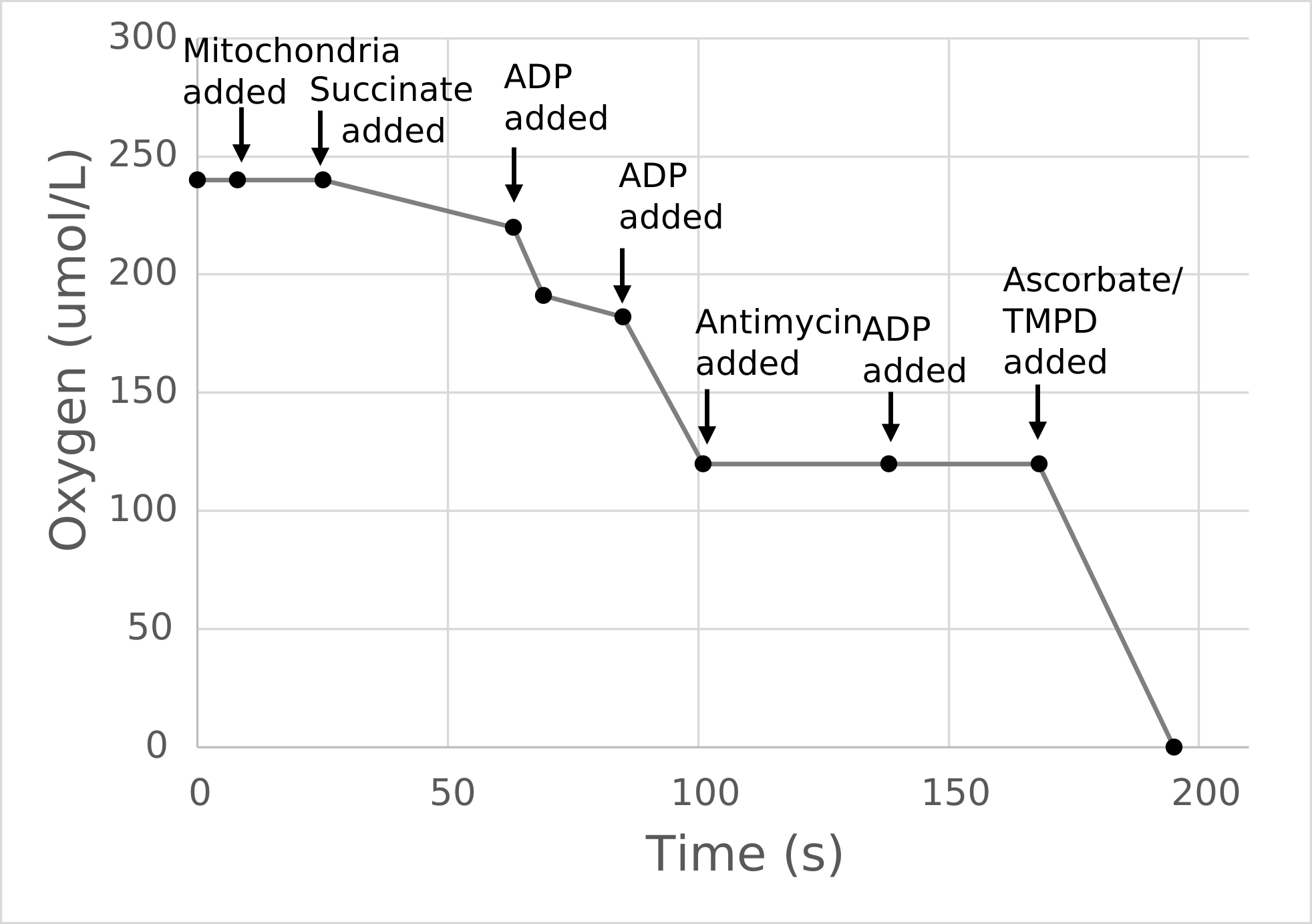
Experiment 3: The effect of Antimycin
- Question 1
- Answer 1
Why does respiration stop after addition of antimycin?
Antimycin is an inhibitor of complex 3. It must inhibit the flow of electrons downstream of Complex 2 (Succinate was used as a substrate). Although not shown, it blocks respiration sustained by succinate or malate.
- Question 2
- Answer 2
Why does respiration resume after addition of ascorbate/TMPD?
Ascorbate and TMPD can feed electrons into cytochrome c. It allows resumption of respiration after blocking complex 3. Conclusion: cytochrome c must translocate electrons downstream of complex 3 into complex 4.
Experiment 4: The effect of Cyanide (KCN).
- Question 1
- Answer 1
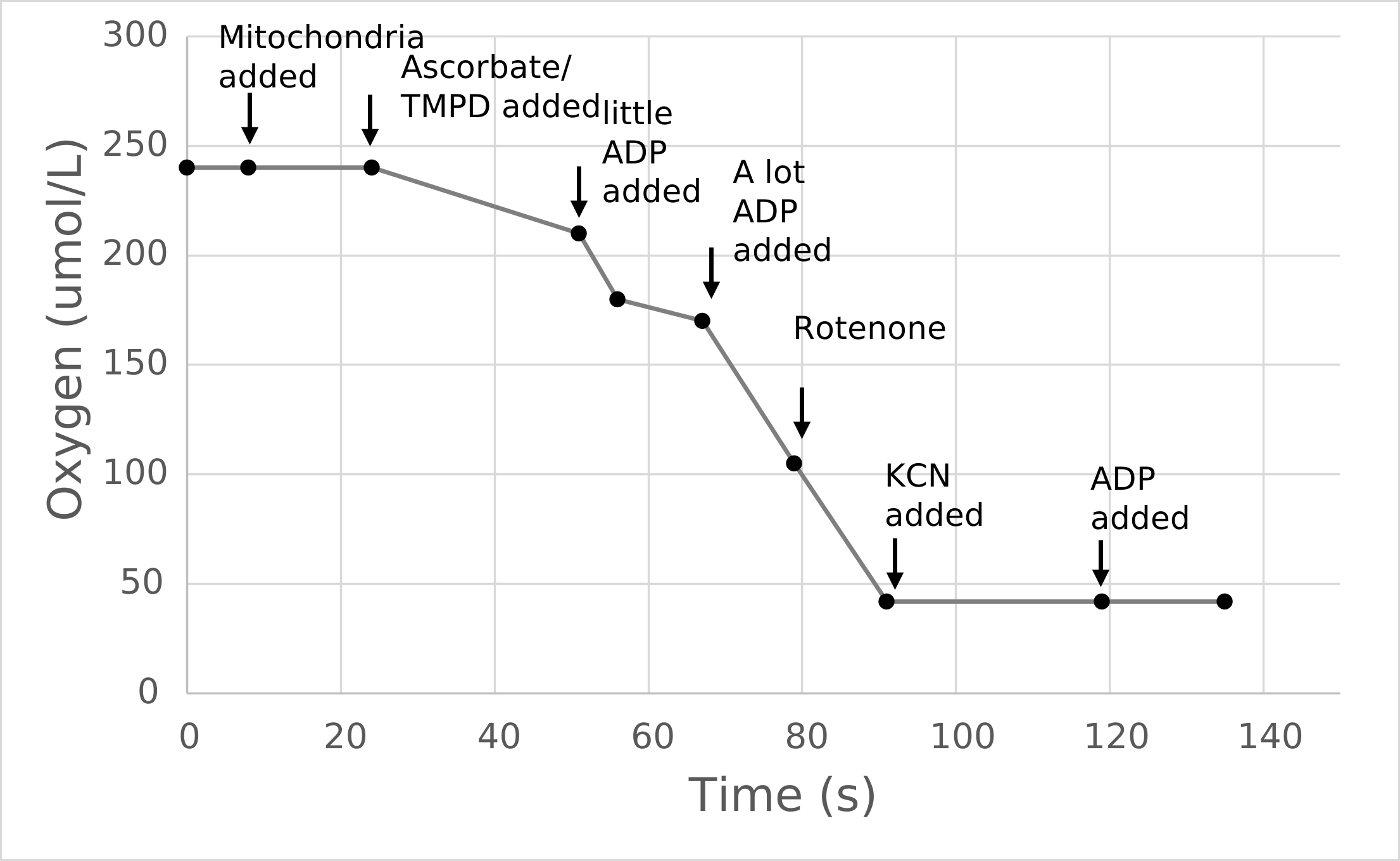
Why does respiration start after addition of ascorbate/TMPD?
We feed electrons into cytochrome c, which in turn will deliver electrons to complex IV, which reduces oxygen to water.
- Question 2
- Answer 2
Why does rotenone have no effect on respiration?
Rotenone inhibits Complex I and is not involved in respiration under the conditions of the experiment.
- Question 3
- Answer 3
What happens after addition of KCN?
Cyanide blocks Complex IV. Regardless of where electrons are fed into the respiratory chain, it will be blocked by KCN. Although not shown, the result would be the same whether malate, succinate or ascorbate/TMPD were used as electron donors.
Experiment 5: The effect of Oligomycin
- Question 1
- Answer 1
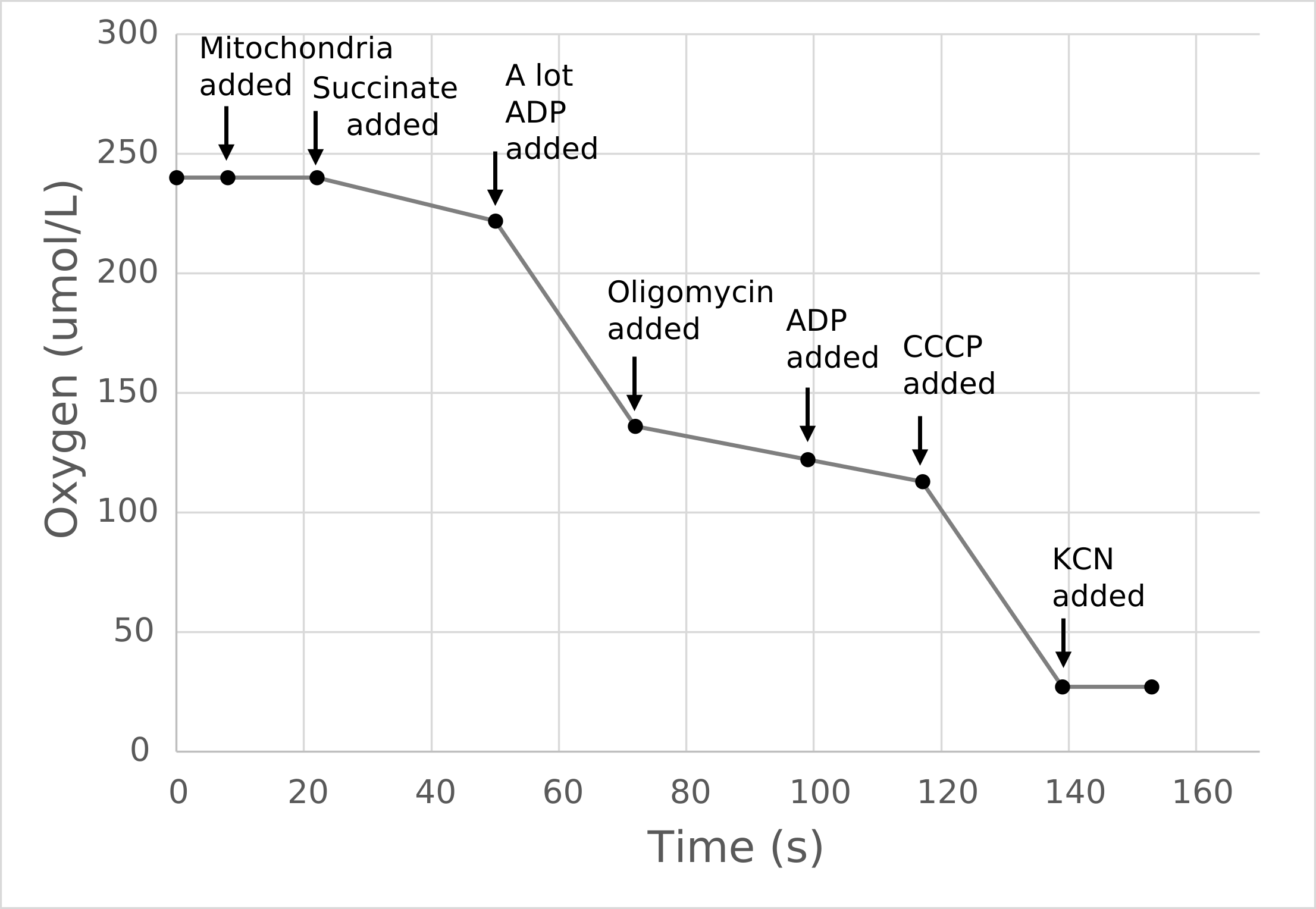
Why is oxygen consumption reduced after addition of oligomycin?
This experiment demonstrates the coupling between ATP synthesis and the respiratory chain. If ATP synthesis is blocked, the proton motive force will build up and generate backpressure onto the respiratory chain. The respiratory chain will stop (and with it the TCA cycle).
- Question 2
- Answer 2
What happens after addition of CCCP?
Now protons transported across the membrane by the respiratory chain are passed back into the matrix, without involving ATP synthase. As a result, the backpressure is relieved, and the respiratory chain runs at maximum speed.
- Question 3
- Answer 3
What happens after addition of KCN?
KCN binds to and blocks Complex IV, oxygen consumption ceases.