 Skip to content
Introduction
Physiology was initially dominated by anatomy and descriptive approaches. The function of organs was deduced from their anatomy without doing experiments. Physiology only became a science when experimental approaches were used. The first true physiologist was William Harvey (1578-1657), the discoverer of the blood circulation. As a broader discipline, physiology germinated in Leyden during the early eighteenth century in the “Institutes of Medicine” of the illustrious Herman Boerhaave (1668-1738). He also wrote the first textbook of physiology, the ‘Institutiones medicae’. John Hunter (1728-1793) of London and Albrecht v. Haller (1708-1777) of Göttingen and Bern developed it into an independent branch of medicine. Haller wrote the ‘Elementa physiologiae humani’, a complete compilation of physiological knowledge and interpretation in 8 volumes.
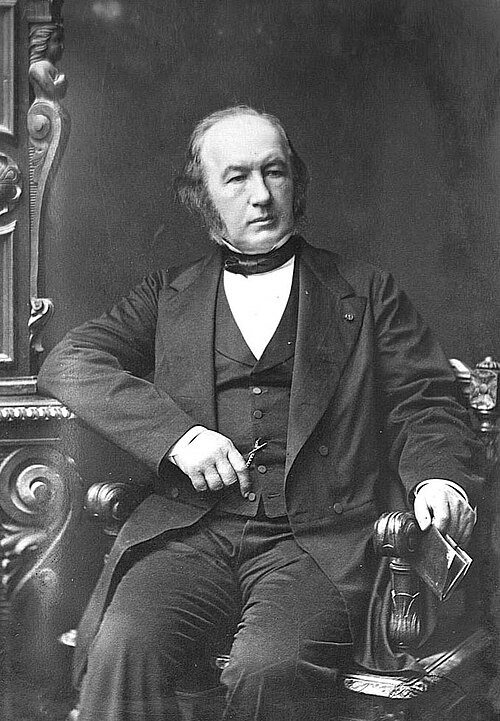
Rigorous experimental physiology started in France in the early 19th century. In particular, François Magendie (1783-1855) in Paris became weary of explaining the unexplainable by the assumption of a vital force and, lacking better interpretations, wisely contented himself with gathering isolated facts by experimental methods and left correlations to posterity. His most prominent pupil was Claude Bernard (1813-1878), the preeminent physiologist of the 19th century in France. Bernard had an international lab, mentoring many future physiologists, such as Willy Kühne, Peter Ludwig Panum, Louis Antoine Ranvier, Isidor Rosenthal and others.
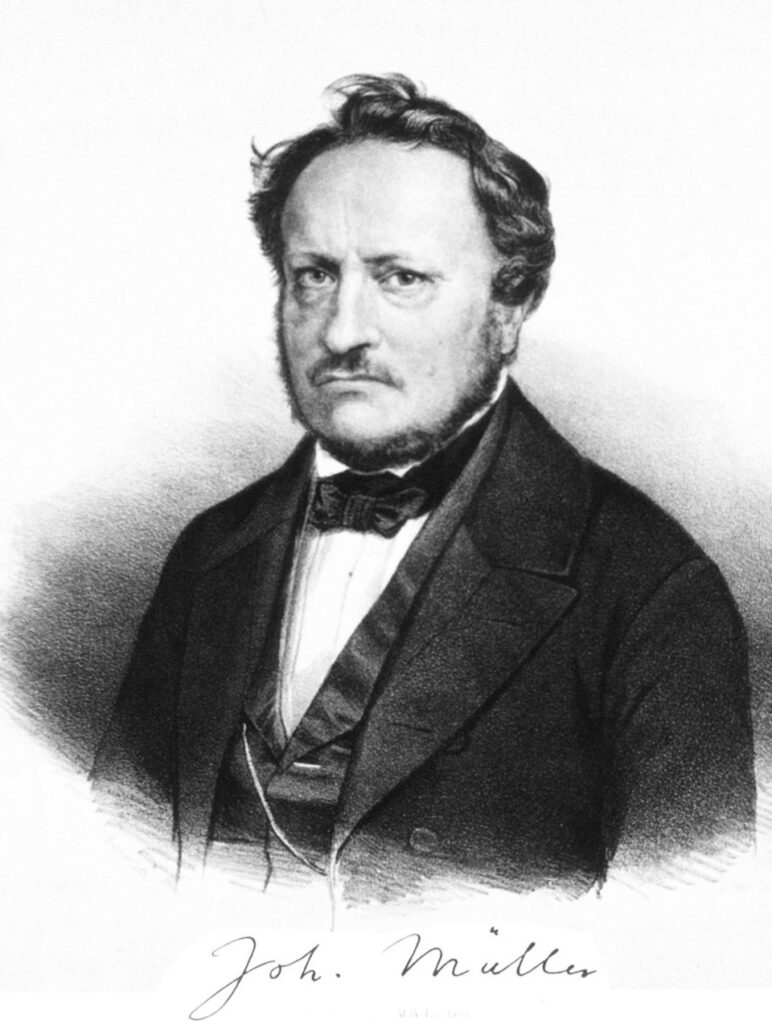
Around the same time the German school of experimental physiology was initiated by Johannes Peter Müller (1801–1858). He is often regarded as the “father of modern physiology” for his role in transforming biology and medicine from speculative philosophy into a rigorous experimental science. His achievements span several disciplines, including neurophysiology, embryology, and comparative anatomy. Between 1833 and 1840, he published the Handbuch der Physiologie des Menschen (Handbook of Human Physiology). It became the definitive textbook for the 19th century, synthesizing all known knowledge of chemistry, physics, and anatomy as they applied to the human body.
Müller’s scientific method pushed the field away from “Naturphilosophie”. This philosophical school was popular in Germany at the time and saw nature as an organic whole with a “vital force”. Its members derived knowledge from reasoning not experimentation. Müller and his pupils moved physiology toward evidence-based experimentation. Müller was an excellent mentor and trained many of the preeminent scientists of the 19th century, including: Hermann von Helmholtz (1821-1894) , Rudolf Virchow (1821-1902, The father of modern pathology), Theodor Schwann (1810-1882, Developer of Cell Theory), Ernst Haeckel (1834-1919, The father of developmental Biology), Ernst Wilhelm von Brücke (1819-1892), Albert von Kölliker (1817-1905, discoverer of mitochondria) and Emil du Bois-Reymond (1818-1896, The father of electrophysiology). Equally influential as Johannes Peter Müller was Carl Ludwig (1816–1895), who was trained as an anatomist and has been called the “greatest physiology teacher of all time”. He developed many of the tools and methods of experimental physiology. Ludwig was famously unselfish. He often did the bulk of the work on experiments but refused to put his name on the final papers, allowing his students to take the full credit. His laboratory became a center for physiological research and trained many more famous physiologists (like Pavlov, Gaskell, Stirling, Bohr, Fick, Bowditch, Voit and Einthoven) than perhaps any other teacher of physiology in history.
Out of Müller’s laboratory developed the influential Berlin school of physiological materialism, led by Ernst Wilhelm von Brücke, Emil du Bois-Reymond, Hermann von Helmholtz and Carl Ludwig.
Teaching physiology was for the first time recognized as an integral part of the medical curriculum through the appointment of William Porterfield to a Chair of the Institutes of Medicine at Edinburgh in 1724. In 1796 Reil issued the first volume of the first journal of physiology, Archiv fur die Physiologie, which thereafter had an interrupted course under various titles until 1878. The first International Congress of Physiologists was held at Basel in 1889.
William Sharpey (1802-1880) and later Michael Foster (1836-1907) introduced Müllers concepts into British Physiology and trained the next generation of physiologists.
Henry Pickering Bowditch (1840-1911) also studied with Ludwig and brought the principles of modern physiology to the United States.
If there is one overarching principle in physiology, it is homeostasis. It refers to the ability of an organism to maintain a harmonized internal milieu. Almost all functions in physiology are tightly regulated and controlled to either adapt to physiological demands, or to maintain constancy. Typical features underlying homeostasis are the oxygen saturation of blood, blood pressure, salt and water balance etc. The homeostasis principle was first formulated by Claude Bernard and further detailed by Walter Cannon (1871-1945) and Lawrence Joseph Henderson (1878-1942).
In the subchapters, I will develop the history of physiology based on concepts and organ function. I will outline the main discoveries up to the middle of the 20th century. I will consider the onset of “Molecular Physiology” as the beginning of contemporary physiology and only occasionally mention molecular conclusions to long inquiries of physiological principles.
Below you can find a timeline of history up to the end of the 19th century.
A timeline of Physiology
Physiology before the 18th century
| Year | Person | Discovery |
|---|---|---|
|
Around 1250 |
Ibn al-Nafis |
Concept of the pulmonary circulation |
|
1452-1519 |
Leonardo Da Vinci |
Heart as a muscle with valves pumping blood |
|
1543 |
Andreas Vesalius |
Detailed anatomy of the human body |
|
1553 |
Miguel Serveto |
Pulmonary circulation |
|
1555/1603 |
Jacobus Sylvius/Hieronymus Fabricius |
Venous valves |
|
1610 |
Johannes Kepler |
Correct interpretation of the light path in vision, accommodation |
|
1614 |
Santorio Santorio |
Balancing metabolism (loss of water during metabolism) |
|
1628 |
William Harvey |
Blood circulation |
|
1651 |
Jean Pecquet |
Ductus thoracicus and lymphatic system |
|
1660 |
Robert Boyle |
Life requires oxygen, relation between pressure and volume of gases. |
|
1661/1666 |
Marcello Malphigi |
Capillaries in the lung/Liver produces bile, anatomy of the kidney |
|
1662-1665 |
Several |
Foundation of Scientific Societies |
|
1662 |
Rene Descartes |
‘De Homine’, attempt to explain human physiology as a mechanical machine |
|
1666 |
Marcello Malpighi |
First description of fibrin in blood clotting |
|
1666 |
Jan Swammerdam |
Muscle nerve preparation, muscles do not swell during contraction, reciprocal contraction |
|
1667 |
Niels Stensen (Steno) |
Muscle contraction is caused by rearrangement of fibers |
|
1669 |
Richard Lower |
Detailed description of heart anatomy and function.
Air mixes with blood in the lungs upon which it changes its colour. |
|
1674 |
Antonie van Leeuwenhoek |
Red blood cells |
|
1674 |
John Mayow |
Respiration provides organism with „spiritus nitroaereus“ (oxygen not yet discovered) |
|
1677 |
Francis Glisson |
Muscles do not swell during contraction, muscles are excitable |
|
1679 |
Franciscus Sylvius |
Digestion is similar to fermentation and requires saliva and pancreatic juice |
|
1680 |
Giovanni Alfonso Borelli |
‘De motu animalium’, study of the mechanics of movement.
Kidneys filter blood. |
The 18th century
| Year | Person | Discovery |
|---|---|---|
|
1700 |
Giorgio Baglivi |
First suggestion of an autonomous heartbeat |
|
1708 |
Herman Boerhaave |
‘Institutiones medicae’, first textbook of physiology, Leyden becomes the center of medical research. |
|
1715 |
Antonie van Leeuwenhoek |
Microscopic structure of striated muscle fibers |
|
1733 |
Stephen Hales |
First measurement of blood pressure |
|
1738 |
Daniel Bernoulli |
First quantitative estimate of how much mechanical work the human heart performs in pumping blood. |
|
1739 |
Francis Glisson |
Muscle is an “irritable” (excitable) tissue |
|
1749 |
Jean Baptiste Senac |
First mentioning of leukocytes (globules blancs du pus) |
|
1752 |
Rene Antoine Ferchault de Reaumur |
First experiments to study digestion |
|
1757 |
Albrecht von Haller |
‘Elementa physiologiae corporis humani’, summarizes the knowledge in 8 volumes; heart continues to beat when separated from all nerve fibers. |
|
1771/1774/1777 |
Carl Wilhelm Scheele, Joseph Priestley, Antoine Lavoisier |
Discovery of oxygen and its role in combustion |
|
1773 |
William Hewson |
Discovery of leukocytes |
|
1775 |
Felice Fontana |
All-or-none response of heart contraction and refractory phase |
|
1780 |
Luigi Galvani |
Muscles twitch after applying electricity |
|
1782 |
Joseph Black |
Discovery of “fixed air” (carbon dioxide) |
|
1783 |
Lazzaro Spallanzani |
Gastric juice can digest food outside the stomach. |
|
1784 |
Georg Prochaska |
Reflex actions are involuntary, stereotyped, and mediated by the spinal cord, not the brain |
|
1786 |
William Cruikshank |
The Anatomy of the Absorbing Vessels of the Human Body, modern description of the lymphatic system. |
|
1789 |
Christoph Girtanner |
Suggests that oxygen is taken up by blood in the lungs |
|
1794 |
Luigi Galvani |
Animals have endogenous electrical signals (animal electricity) |
|
1796 |
Johann Christian Reil |
First journal dedicated to physiology (Archiv fuer die Physiologie) |
The 19th Century (General trends)
| Year | Person | Discovery/Event |
|---|---|---|
|
1838/1839 |
Theodor Schwann/Matthias Schleiden |
Tissues and organs are made up of cells (Cell theory) |
|
1840 |
Johannes Mueller |
Handbuch der Physiologie des Menschen |
|
1868 |
Eduard Pflueger |
Pflueger’s Archiv fuer die gesamte Physiologie |
|
1876 |
John Burdon Sanderson et al. |
Foundation of the British Physiological Society |
|
1878 |
Michael Foster |
Journal of Physiology |
The 19th Century (Cardiovascular Physiology)
| Year | Person | Discovery |
|---|---|---|
|
1828 |
Jean Léonard Marie Poiseuille |
Invention of the Haemodynamometer (mercury to balance blood pressure) |
|
1825/1827 |
Wilhelm Eduard Weber, Ernst Heinrich Weber |
Application of wave theory to the flow of blood in elastic blood vessels |
|
1845 |
Ernst Heinrich Weber, Eduard Friedrich Weber |
Inhibitory action of the vagus nerve on the heart |
|
1847 |
Carl Ludwig |
Invention of the kymograph |
|
1852 |
Hermann F. Stannius |
Atrioventricular Block, autonomy of the heart beat |
|
1852 |
Claude Bernard, Charles Brown Sequard |
Control of blood vessels by the nervous system (Vasomotor control) |
|
1856 |
Carl Ludwig |
Perfused heart method |
|
1859 |
Michael Foster |
Autonomy of the heartbeat (Beginning of the end of the neurogenic theory) |
|
1867 |
Albert von Bezold |
Sympathetic innervation accelerates the heartbeat |
|
1870 |
Adolf Eugen Fick |
Cardiac output equation |
|
1871 |
Henry Pickering Bowditch |
“all or none” response and “staircase phenomenon” of the heart |
|
1874 |
Hugo Kronecker, William Stirling |
Refractory phase of the heart |
|
1879 |
John Scott Burdon-Sanderson |
First recordings of the heart action potential |
|
1883 |
Walter Gaskell |
Modern concepts of autonomic heartbeat and contraction |
|
1883 |
Sydney Ringer |
Calcium is required for heartbeat |
|
1889 |
Charles Potain |
Sphygmanometer |
|
1889 |
Augustus Desire Waller |
First recording of the electrocardiogram |
The 19th century (Blood and lymphatic system)
| Year | Person | Discovery |
|---|---|---|
|
1830 |
Benjamin Guy Babington |
Content |
|
1842 |
Alfred Donne |
Discovery of platelets |
|
1843 |
Gabriel Andral/ William Addison |
Discovery of white blood cells |
|
1843/1846/1867 |
William Addison/Augustus Waller/Julius Cohnheim |
Extravasation of leukocytes from blood to tissue |
|
1847 |
Rudolf Virchow |
Definition of fibrinogen |
|
1868 |
Felix Hoppe-Seyler |
Pioneer work on haemin, haematin and haematoporphyrin, haemoglobin is the colouring matter of the blood. Start of physiological chemistry. |
|
1868 |
Guilio Bizzozero/Ernst Neumann |
Mature erythrocytes are derived from nucleated red cells in the bone marrow. |
|
1872 |
Hermann Adolf Alexander Schmidt |
Transformation of fibrinogen into fibrin is an enzymatic process. |
|
1878 |
Paul Ehrlich |
Blood cell staining to discriminate subpopulation of white blood cells |
|
1879 |
Olof Hammersten |
First purified fibrinogen preparation by repeated precipitation with half-saturated NaCl. |
|
1880 |
Alexander Buchanan |
A blood clot initiates blood clotting in blood plasma |
|
1886 |
Ilya Metchnikoff |
Discovery of phagocytosis |
|
1892 |
Alexander Schmidt |
Discovery of Thrombin (Fibrin Ferment) |
The 19th century (Respiration)
| Year | Person | Discovery |
|---|---|---|
|
1803 |
Lazzaro Spallanzani |
Respiration occurs in tissues |
|
1837 |
Gustav Magnus |
Blood gas analysis |
|
1857 |
Lothar Meyer |
Oxygen is tightly bound in blood |
|
1858 |
Claude Bernard |
Carbon monoxide displaces oxygen from blood |
|
1862 |
Felix Hoppe-Seyler |
Crystallization of Hemoglobin |
|
1872 |
Eduard Pflueger |
Quantification of tissue respiration |
|
1885 |
Friedrich Miescher |
Rising carbon dioxide in blood increases respiration |
|
1892 |
John Scott Haldane |
Quantification of gas exchange in humans |
References
Franklin, K. J. (1949). A short history of physiology.
Rothschuh, K. E. (1953). Geschichte der Physiologie. Springer-Verlag.
Coller, B. S. (2015). Blood at 70: its roots in the history of hematology and its birth. Blood, The Journal of the American Society of Hematology, 126(24), 2548-2560.
Hajdu, S. I. (2003). The discovery of blood cells. Annals of Clinical & Laboratory Science, 33(2), 237-238.
Pearn, J. (2002). A curious experiment: the paradigm switch from observation and speculation to experimentation, in the understanding of neuromuscular function and disease. Neuromuscular Disorders, 12(6), 600-607.
Wiggers, C. J. (1960). Some significant advances in cardiac physiology during the nineteenth century. Bulletin of the History of Medicine, 34(1), 1-15.
