 Skip to content
Wilhelm Pfeffer (1845-1920) proposed in 1887 that cells generally were surrounded by a semipermeable membrane. Charles Ernst Overton (1865-1933) then found at the end of the 19th century that fat soluble substances passed through membranes more readily than water soluble ones and concluded that membranes acted like fatty oils. In 1925, Hugo Fricke and Sterne Morse, working on erythrocytes measured a membrane capacity of 0.81 μF/cm2. With a dielectric constant of 3 (an underestimation) he calculated a transmembrane thickness of 3.3 nm, implying a monomolecular structure. That biological membranes could be made up of a lipid bilayer was first proposed in 1925 by Evert Gorter (1881-1954) and Francois Grendel (1897-1969). James Danielli (1911-1984) and Hugh Davson (1909-1996) added proteins to the surface of the membrane in 1935. Seymour Jonathan Singer and Garth L. Nicolson published their landmark paper, “The Fluid Mosaic Model of the Structure of Cell Membranes,” in Science in 1972, which established our current model of biological membranes.
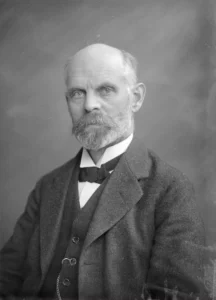
Adolf Eugen Fick (1829–1901) was a German physiologist and physicist whose work bridged the gap between hard physics and medical science. At just 26 years old, Fick derived the mathematical laws that govern how particles move from areas of high concentration to low concentration. He based these on the analogy of heat flow (Fourier’s Law). Fick’s First Law states that the “flux” (rate of movement) of a substance is proportional to the concentration gradient. Fick’s Second Law predicts how diffusion causes the concentration to change over time. Fick’s laws are used to calculate how ions diffuse down concentration gradients and how oxygen diffuses across cell membranes.
Walther Nernst (1864-1941, Nobel Prize 1920), a German physicist, developed the eponymous equation in 1887. The equation quantifies the electrical potential generated by unequal concentrations of an ion separated by a membrane that is permeable to the ion.
The idea of an ion channel was first proposed in 1840 by Ernst Wilhelm von Brücke (1819-1892) to explain osmotic processes in the pig bladder. In 1955 the English biophysicists Alan Llyod Hodgkin and Richard Keynes (1919-2010) proposed that K+ ions cross the membrane co-ordinately through narrow tubes or channels and not by free diffusion. In their words: “ions cross the membrane along a chain of negative charges or through narrow tubes or channels… in which they are constrained to move in single file.” The nature of the tubes was unclear at the time. The concept of proteinaceous ion channels slowly gained acceptance in the 1960, promoted among others by Bertil Hille (born 1940) and Clay Armstrong (born 1934).

The concept of carrier proteins and pumps (membrane transporters as opposed to ion channels) in biological membrane developed in the 1930s based on observations of intestinal absorption of different carbohydrates and the permeability of erythrocytes. One of the first to notice selective transport of sugars in 1925 was Carl Cori (1896-1984), when he measured that in the intestine sugars such as glucose and galactose, were quickly absorbed, while others were absorbed more slowly. The permeability of erythrocytes to ions and carbohydrates is also selective, typically measured as swelling or shrinking of erythrocytes in different solutions. Even earlier, but overlooked at the time, Charles Overton (1865-1933) showed that some of the permeabilities in erythrocytes could be blocked by copper salts, suggesting a specific mediator of the permeation process. In 1902 Charles Overton already pointed to a problem in the maintenance of ion concentrations when he wrote “Consider that, in the course of 70 years, heart muscle cells contract about 24 × 108 times and respiratory muscles about 6 × 10⁸ times. If some sodium ions enter and some potassium ions leave during each contraction, then the differences between internal and external cation concentrations would gradually be levelled out unless there is some mechanism at work which opposes this equilibration. In actual fact, our muscles contain, so far as I am aware, just as much potassium and as little sodium in old age as they do in early youth.” Further evidence came from the increased interest in blood conservation during the Second World War. It could be demonstrated that K+ loss from erythrocytes was related to the slowdown of metabolism. Finally, cation fluxes seemed able to restore ion asymmetries in the recovery period after muscle stimulation. This evidence led Robert Dean to postulate in 1941 that the agent of ion movement against the gradient could result from the activity of some “pump” located in the muscle fibre membrane. The Croonian lecture by August Krogh in 1945 was also an influential opinion in favour of the hypothesis that Na+/K+ asymmetries were the result of active transport. The final steps in the discovery of the Na+/K+-ATPase, which maintains the asymmetric ion concentration between cells and their surroundings, were made by Jens Christian Skou (1918-2018, Nobel Prize 1997) and Robert L. Post (1920-2021). Post first reported on the movements of sodium and potassium ions across the plasma membrane of human red blood cells in 1955 at a meeting of the American Physiological Society. In 1957, Jens Christian Skou published his observation that ATP, when exposed to crab nerve tissue, is cleaved rapidly only when sodium and potassium ions are simultaneously present. For this “first discovery of an ion-transporting enzyme, Na+,K+-ATPase,” Skou was awarded the 1997 Nobel Prize in chemistry, but Robert L. Post made Skou aware of the movement of ions and use of ouabain to inhibit the process.

The concept of membrane carriers equilibrating the concentration of metabolites across cell membranes was established through the efforts of Wilfred F. Widdas (1916-2008), Thomas Rosenberg and Walther Wilbrandt (1907-1979). They pioneered the study of carrier-mediated membrane transport. Their work in the 1950s and 1960s helped establish the concept that a mobile carrier within a membrane could explain phenomena such as countertransport, exchange diffusion, and “uphill” transport against a concentration gradient. Oleg Jardetzky is often credited with developing the alternating access model of membrane transport in 1966, but the concept was clearly outlined in 1957 by Peter Mitchell (1920-1992).
References
Catacuzzeno, L., Michelucci, A., & Franciolini, F. (2025). The crucial decade that ion channels were proven to exist: The vision of Bertil Hille and Clay Armstrong and how it came through. Pflügers Archiv-European Journal of Physiology, 477(7), 903-917.
Dean, R. B. (1987). Reminiscences on the sodium pump. Trends in Neurosciences, 10(11), 451-454.
Glynn, I. M. (2002). A hundred years of sodium pumping. Annual review of physiology, 64(1), 1-18.
Lombard, J. (2014). Once upon a time the cell membranes: 175 years of cell boundary research. Biology direct, 9(1), 32.
Boyd, R. (2009). Wilfred F Widdas. Physiology News, No. 74
Robinson, J. D. (2013). Moving questions: A history of membrane transport and bioenergetics. Springer.
